


Cart
You have no items in your shopping cart
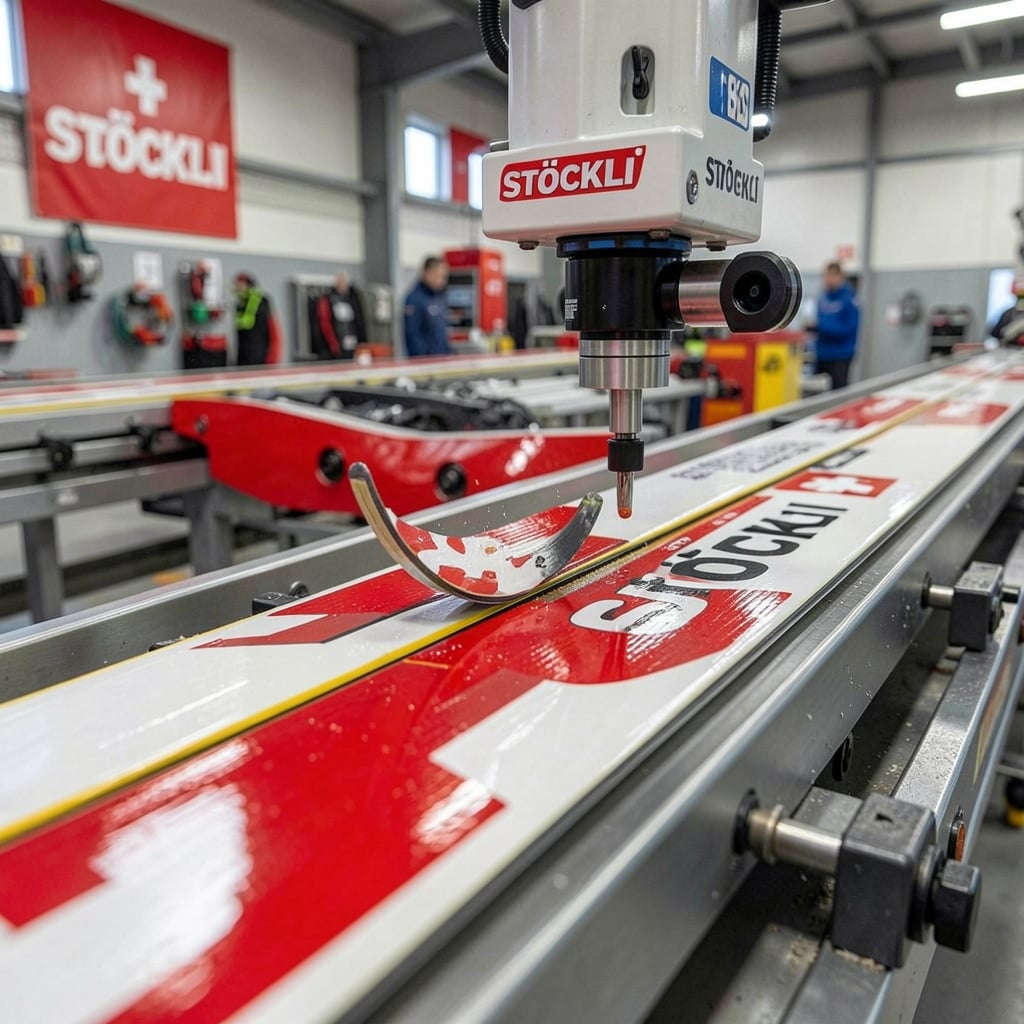
Stöckli skis have a reputation in race circles that is difficult to explain until you have skied on a pair. The performance feels different from other high-end race skis, and the difference is not marketing. It comes from where and how these skis are made. Stöckli is the only remaining ski manufacturer in Switzerland, and every pair of Stöckli race skis goes through more than 140 manual steps before it leaves the factory in Malters.
That number matters. Mass-produced skis from large manufacturers go through significantly fewer manual operations, with automation handling much of the layup, pressing, and finishing. At Stöckli, CNC machines handle precision shaping, but the construction is a hands-on process, executed by a team of about 80 people at a factory that makes roughly 360 pairs per day.
Josef Stöckli built his first pair of skis in 1935 from ash wood in his parents' workshop in Wolhusen, Switzerland. He bent the boards into shape by steaming them in his mother's wash tub. The skis were apparently good enough that colleagues started ordering pairs, and a factory followed.
That factory, now in Malters in the Canton of Lucerne, is the last of its kind. Every other Swiss ski manufacturer has closed or moved production offshore. Stöckli survived by doing the opposite of what the market pushed toward. Instead of scaling up output and automating, the company maintained a selective dealer network and kept every step of production in Switzerland.
Today the Malters facility produces around 80,000 pairs per year. For context, the largest mass-market brands produce many times that number. The smaller output is not a constraint. It is a production philosophy that makes quality control possible.
This is the detail that dealers and racers who visit the Malters factory tend to remember most. Every Stöckli ski involves more than 140 individual manual operations, from raw material preparation through to final inspection and base grinding.
CNC milling establishes the sidecut geometry and core profile. Those cuts are machine-controlled because the tolerances demand it. But the layup, the lamination, the sidewall work, and the hand finishing are done by experienced workers who know what a correctly built ski feels like before the press closes.
The result shows an unusual consistency between pairs in the ski industry. When a racer picks up a new pair of Laser FIS GS skis, they are not hoping they ski like the previous pair. They are counting on it.
Stöckli race skis are built around a wood core, with species and density profiles matched to each discipline's flex requirements. The core is not a commodity wood blank. It is engineered to produce the flex pattern the ski needs before any laminates are added.
Over the core go titanal laminates, which add torsional rigidity and damping without excessive weight. Titanal stiffens the ski in a way that improves edge hold on hard snow, exactly the condition Killington presents for most of the season. On models like the Laser FIS GS, a Carbon Steering Control (CSC) layer moderates tip engagement and keeps the ski composed at high speed.
The base is a racing-grade graphite compound, faster and more durable than standard sintered bases, and it holds structured waxing treatments longer. For a ski that will be professionally prepped before every race, base quality is not a secondary consideration.
The word skiers use when they switch to Stöckli is "quiet." At speed on hard snow, the ski does not talk back the way other race skis do. No chatter, no vibration through the boot at the point of maximum edge load. The ski does what you ask and does not add noise to the information it gives you.
That quality comes directly from the construction. The hand-finished core, titanal damping layers, and full camber edge contact work together to absorb surface imperfections without giving up grip. On Killington's February groomers, ice patches are cut through rather than deflected. The ski holds the line.
It is the same quality Marco Odermatt uses at World Cup speed. Odermatt set the all-time men's World Cup points record on Stöckli equipment, and Tina Maze holds the equivalent women's record on the same brand. Both outcomes reflect what consistent, high-quality manufacturing delivers when the stakes are highest.
Stöckli does not sell through every ski shop or online marketplace. The brand selects dealers based on whether the staff understands the product well enough to match it correctly to each buyer and whether the shop can provide the tuning the ski is designed to receive.
Peak Performance is one of those dealers. We carry the full Stöckli race lineup, can discuss setup and fit based on real product knowledge, and provide race-specific tuning with the Wintersteiger Jupiter. You can browse every model in the Stöckli race ski lineup at Peak Performance, including FIS GS, FIS SL, and SG options for juniors and adults. Current in-stock inventory and full spec details are on our Stöckli brand page.
A Stöckli ski prepared correctly is a different experience from one that leaves the factory in shipped condition. The factory base grind is the starting point. Event-specific structure and edge bevels finish the job.
At Peak Performance, Stöckli race skis are prepped with discipline-matched structures: Hoop on SL, Tech on GS, Speed on SG. Edge angles are set by discipline — SL at 0.5 degrees base and GS at 0.7 degrees base, with side edges at 3 degrees for both — as a starting point. These are standard recommendations, but Peak can tune to very specific angles based on what each skier wants. That includes variable edge, where the base edge angle changes along the ski's length, typically sharper underfoot and a little less sharp at the tips and tail. The Swiss manufacturing and a precision race tune together are the full equation.
The race gear guide on The Edge covers the demands of each discipline and explains why the choices of skis, bindings, boots, and poles are important for building a complete race setup.
Comments
Be the first to comment...